
Close Menu
NERDBOT
    Facebook X (Twitter) Instagram YouTube
    Subscribe
    NERDBOT
    • News
      • Reviews
    • Movies & TV
    • Comics
    • Gaming
    • Collectibles
    • Science & Tech
    • Culture
    • Nerd Voices
    • About Us
      • Join the Team at Nerdbot
    NERDBOT
    Home»Nerd Culture»The History of Liberal Superman
    Nerd Culture

    The History of Liberal Superman

    Kurt BrozBy Kurt BrozAugust 6, 20188 Mins Read
    Share
    Facebook Twitter Pinterest Reddit WhatsApp Email

    Regardless of your political leanings or personal beliefs, you have to accept the fact that it’s a very rough time for the world right now. In the US alone, 8 out of 10 Americans are living paycheck-to-paycheck and some 18% of US adults suffer from depression. Anyway you slice it, our current world is kind of crappy for a lot of folks. In a time when the rich are getting richer and, even with historic low unemployment and low world poverty rates, wages for most Middle and Lower Class folks are stagnating in the face of rising prices due to general inflation and a looming trade war. Farmers are facing questions about their ability to make ends meet. All of our grand technology can’t save us alone.

    There’s a lot of hopeless people in this world. I know some of them. And many of those folks are friends and family in the middle of our country – the “Flyover States” – which those of us are insulated slightly by our coastal leanings. Oh, and though many of us white and semi-successful folks forget them, minorities are facing a terrible backlash and racism in the open not seen in a long time.

    Which brings me to the point of my grand musings. We need Superman back. We need a return to the real, classic, populist hero of his origins well though the Silver Age.

    Regardless of what you angrily shout on social media, art has been and always will be political. Superman, the harbinger of American exceptionalism and flag-waving love, was not always this way. The Superman many folks under 30 think of is the Big Blue Boy Scout, the joke licking at Presidential boots in Frank Miller’s The Dark Knight or suffering troubled decisions lead by an erratic parent on whether or not to use his powers at all. For a long, long time Superman was a hero for the masses, a populist in the sense of caring about the needs of the common man, above all else, who brought hope. He obeyed laws and respected Presidents, but he wasn’t afraid to go against evil and corruption to help people. In the comics, Superman would renounce his citizenship or give up his life if it went being a better person.

    Superman the character was created by Middle Class Jewish Americans living in a flyover state suffering from economic devastation, racism, and all the other stuff that comes from living in Cleveland, Ohio. I know more than most as I grew up in Cleveland. Jerry Siegel and Joe Schuster, both Jewish Americans from a recent immigrant lineage, built the archetype of the Aryan hero we all know and accept from a simple, Jewish heritage. Superman’s creators had parents that may have barely spoken English and had childhoods steeped in the Jewish-American experience, for better or worse. Thus at it’s heart Superman and his creators are both the true American success stories: immigrants or children of immigrants who make a major, positive impact on the world.

    In those early stories, Superman was doing one thing consistently: Fighting for the common man. Superman might have been an alien that was essentially a Greek god come to America, but he was also much more. He was built from the ground up as an illegal alien crashed in Kansas, the breadbasket of American that was currently suffering the results of decades of poor land management, who moved to a big city modeled after that bastion of multiculturalism in the Midwest, Chicago, becoming the Metropolis we know and love. Superman was a man who loved his adopted parents and became a news reporter bent on rooting out the corruption and crime in the city while his alter ego could tackle those things that a normal man – or the police – could not.

    Superman, the man who was the champion of American exceptionalism and justice for so many decades, would now be a villain to many Americans supporting the far-right. He was an illegal immigrant reporter with a liberal bias. His origins and history are sprinkled with a little bit of Jewish heritage, and he was good friends JFK with Muhammad Ali.

    We need to inject politics and hope into Superman again, especially in the movies. Superman doesn’t need to go to a voting booth or announce his presidential choice. In fact, he has actively been against doing so for fear or swaying elections in the comics. Though, sorry fans, Wonder Woman is a Republican and Batman is a Democrat. So, Superman shouldn’t be waving a flag and shouting pro-Democrat or pro-Republican statements. That’s not my Superman and he’s not the one we deserve right now. That isn’t hope and that isn’t a populist hero.

    Superman is the guy who fights the 80’s archetype of the corrupt billionaire with misplaced importance, Lex Luthor, because he believes in the good of the common man. Superman fights for miners, farmers, minorities, and anyone who needs a hand and isn’t as likely to get one as someone like Lex Luthor. Yes, he should fight monsters and have big epic battles, but this isn’t 1976 and we aren’t children anymore. As a collective society, we are intelligent people and we deserve intelligent art.

    Superman should be a hopeful, optimistic populist who stands opposed to corrupt businesses and evil men. He’s the guy who stops and spends 5 minutes to help a suicidal girl down from a ledge. He’s not and should never be the idiot who destroys a city or kills someone before trying every possible option. He should be, above all else, a symbol of hope for the normal person. This is in opposition to many of the genius and billionaire characters like Batman and Iron Man. He’s a guy from Kansas created by Jews from Cleveland for the purpose of telling fun, hopeful stories. There’s no reason DC can’t bring that to our time now make his world look like the one we live in: gangsters replaced by gangs, Nazi threats replaced by drug addiction, and villains that have leanings in the issues of today… extremist on the right and left, environmental disasters, terrorism…

    Historically, all of your favorite heroes have been born by and molded by politics and have expounded hope. The X-Men and Black Panther lept from the Civil Rights Movement and into comics. Iron Man and his villains were a reflection of the Cold War. Wonder Woman was designed to be a positive heroic model for women. Batman stood against the crime and corruption of the classic Boss era of New York politics and the suffering of the depression and prohibition. The Silver Surfer became a symbol of counter culture. The Green Arrow and Green Lantern became a duo of opposition – one left, one right – working to battle drug addiction and crime while overcoming their issues.
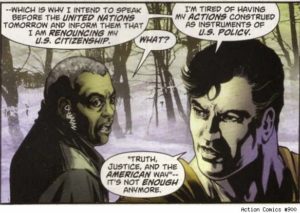
    Above all else, we need a Superman who fights for the people AND for a reason, AND to bring us all a little bit of hope at the end of the day… Heroes are designed to do that. Violence and moping and suffering can make for fantastic stories, but Superman isn’t Batman or Wolverine. Superman is the guy who winks at the camera, knowingly, to remind you that he’s out there… and you aren’t alone. It’s ok to enjoy yourself. Not everything needs to be grim.

    And if demanding Superman be more man and less super, while still being more of a hero and less of a punching idiot bothers you, then that’s fine. If you hate the idea of a Superman who once again fights for the underdog with classical liberal populist ideas of equality, hard work, help, hope, and equity, then that’s fine too. If you’re disgusted by a Superman who once renounced his citizenship and wanted to be a man of the world, not just an American, then that’s your choice. But remember that Superman’s original motto wasn’t just “truth, justice, and the American way”, but rather was a “champion of the oppressed… sworn to help those in need” without considering if that person was a Republican, Democrat, America, illegal immigrant, rich, or poor. Superman was never the guy who punches a person through a building or mopes around about whether he SHOULD help anyone… He was the person who knew he HAD to help others because he COULD.

    Sorry, fans of Batman v. Superman and vocal fans who hate political stories and hopeful endings, Superman was never meant for you. He was meant for the poor kids from Cleveland who needed a little bit of hope… Kids like Siegel, Schuster, and me. He was meant for those of us who couldn’t fly, but wanted to. Superman is and should always be an illegal immigrant raised on a Kansas farm with Midwestern values who wants to root out evil as a reporter and be a genuinely good person. Then, Superman should end his adventures with a sly wink… “Hey guys, I get it. I’m Clark Kent, too. Let’s all have a bit of fun and take a bit of hope home.”

    Do you agree that Superman needs to be more hopeful and heroic? Should superhero movies and TV shows continue the tradition from the comics of reflecting the current fears and dreams on screen? Let Nerdbot know in the comments!


    Do You Want to Know More?

    Share. Facebook Twitter Pinterest LinkedIn WhatsApp Reddit Email
    Previous ArticleStan Lee No Longer Performing Public Autograph Signings
    Next Article Patrick Stewart Welcomed Back To ‘Star Trek’ by ‘Discovery’ Actress
    Kurt Broz
    • Instagram

    THE Kurt Broz is not just a personality for Nerdbot, but he's also the editor-in-chief and a real live scientist! Born on the snowy shores of Lake Erie in good ol' Cleveland, Ohio, Kurt Broz has been there and back again, now residing in sunny Southern California. You can find THE Kurt Broz in cosplay, buying comics, hiking, and even writing for Nerdbot and WLFK Productions. He may be a child of the 80's but he is certainly a man of the world.

    Related Posts

    twin peaks mario kart

    A Round of “Twin Peaks” Mario Kart Anyone?

    April 18, 2026

    Here’s a List of Critically Endangered Crafts

    April 18, 2026
    Trumoo's Vanilla Flavored Blue Milk

    TruMoo® and STAR WARS™ Bring Back Blue Milk for Star Wars Day

    April 18, 2026

    Sandra Bullock’s Comments About A.I. Show the Danger of Ignorance

    April 17, 2026

    “Call of Duty” Film Coming in 2018 Via Paramount

    April 17, 2026
    Lepro Smart LED Floor Lamp

    Lepro Smart LED Floor Lamp Review: Slim Design for Small Spaces

    April 17, 2026
    • Latest
    • News
    • Movies
    • TV
    • Reviews
    Most studios searching for a match-3 level design company are looking for five different things. Some need levels built from scratch, others require a live game rebalanced before churn compounds, and some demand a content pipeline that won't fall behind. These are different problems, and they map to multiple types of companies. The mistake most studios make is treating "match-3 level design" as a single service category and evaluating every company against the same criteria. A specialist who excels at diagnosing retention problems in live games is the wrong hire for a studio that needs 300 levels built in 2 months. A full-cycle agency that builds from concept to launch isn't the right call for a publisher who already has engineering and art in place and just needs the level design layer covered. This guide maps 7 companies for match-3 level design services to the specific problem each one is built to solve. Find your problem first. The right company follows from there. What Match-3 Level Design Services Cover The term "level design" gets used loosely in this market, and this causes bad hires. A studio that excels at building levels from scratch operates dissimilarly from one that diagnoses why a live game's difficulty curve is losing players (even if both describe their service the same way on a website). Match-3 level design breaks into four distinct services, each requiring different expertise, different tooling, and a different type of partner. Level production — designing and building playable levels configured to a game's mechanics, obstacle set, and difficulty targets. This is what most studios mean when they say they need a level design partner, and it's the service with the widest range of quality in the market. Difficulty balancing and rebalancing — using win rates, attempt counts, and churn data to calibrate difficulty across hundreds of levels. Plus, this includes adjusting live content when the data shows a problem. Studios that only do level production typically don't offer this. Studios that do it well treat it as a standalone service. Live-ops level design covers the ongoing content pipeline a live match-3 game requires after launch (seasonal events, new level batches, limited-time challenges) sustained at volume and consistent in quality. This is a throughput and process problem as much as a design problem. Full-cycle development bundles level design inside a complete production engagement: mechanics, art, engineering, monetization, QA, and launch. Level design is one function among many. Depth varies by studio. Knowing which service you need before you evaluate a single company cuts the list in half and prevents the most common mistake in this market: hiring a full-cycle agency to solve a level design problem, or hiring a specialist to build a product from scratch. The List of Companies for Match-3 Level Design Services The companies below were selected based on verified credentials, named shipped titles where available, and the specific service each one is built to deliver. They are ranked by how well their capabilities match the service types outlined above. A specialist who does one thing exceptionally well sits above a generalist who does many things adequately. SolarSpark | Pure-play match-3 level design specialist SolarSpark is a remote-first studio built exclusively around casual puzzle game production. With 7+ years in the genre and 2,000+ levels shipped across live titles including Monopoly Match, Matchland, and KitchenMasters, it is the only company on this list that does nothing but match-3 level design. Level design services: Level production, difficulty curve planning, fail-rate balancing, obstacle and booster logic design, live-ops pipeline, competitor benchmarking, product audit and retention diagnostic. Verdict: The strongest pure specialist on this list. When level design is the specific constraint, SolarSpark is the right choice. What they do well: Every level is built around difficulty curves, fail/win balance, obstacle sequencing, and booster logic, measured against targets before delivery. Competitor benchmarking is available as a standalone service, mapping your game's difficulty curve and monetization structure against current top performers with specific, actionable output. Where they fit: Studios with a live or in-development game that need a dedicated level design pipeline, a retention diagnostic, or a one-off audit before soft launch. Honest caveat: SolarSpark does not handle art, engineering, or full-cycle development. Logic Simplified | Unity-first development with analytics and monetization built in Logic Simplified specializes in Unity-powered casual and puzzle games, with match-3 explicitly in their service portfolio. Operating for over a decade with clients across multiple countries, the studio positions itself around data-informed development: analytics, A/B testing, and monetization are integrated into the production process. Level design services: Level production, difficulty progression design, obstacle and blocker placement, booster and power-up integration, A/B tested level balancing, customer journey mapping applied to level flow. Verdict: A credible full-cycle option for studios that want analytics and monetization treated as design inputs from day one, not as post-launch additions. What they do well: Logic Simplified builds analytics and player behavior tracking into the design process. Their Unity expertise is deep, and their stated MVP timeline of approximately three months is competitive at their price point. India-based rates make full-cycle development accessible without requiring a Western agency budget. Where they fit: Studios building a first match-3 title that needs the full production chain handled by a single vendor, with analytics built in from the start. Honest caveat: No publicly named match-3 titles with verifiable App Store links appear in their portfolio. Ask for specific live game references and retention data during the first conversation before committing. Cubix | US-based full-cycle match-3 development with fixed-cost engagement Cubix is a California-based game development company with a dedicated match-3 service line covering level design, tile behavior, booster systems, obstacles, UI/UX, and full production on Unity and Unreal Engine. 30+ in-house animators can cover the full scope of puzzle game production. Level design services: Level production, combo and difficulty balancing, blocker and locked tile placement, move-limit challenge design, booster and power-up integration, scoring system design. Verdict: A viable full-cycle option for studios that need a Western-based partner with transparent fixed-cost pricing and documented match-3 capability. What they do well: Cubix covers the full production chain in one engagement, with strong visual production backed by an in-house animation team. Their fixed-cost model is a practical differentiator for studios that have been burned by scope creep on previous outsourcing contracts. Staff augmentation is also available for studios that need talent to plug into an existing pipeline. Where they fit: Studios that want a US-based full-cycle partner with predictable budgets, cross-platform delivery across iOS, Android, browsers, and PC, and a single vendor to own the concept through launch. Honest caveat: Named shipped match-3 titles are not prominently listed in their public portfolio. This is a verification gap worth closing during vetting, not a disqualifier on its own. Galaxy4Games | Data-driven match-3 development with published retention case studies Galaxy4Games is a game development studio with 15+ years of operating history, building mobile and cross-platform games across casual, RPG, and arcade genres. Match-3 is a named service line. What distinguishes them from most studios on this list is a level of public transparency about retention data. Their case studies document real D1 and D7 numbers from shipped titles. Level design services: Level production, difficulty curve development, booster and obstacle design, progression system design, LiveOps level content, A/B testing integration, analytics-based balancing. Verdict: The most transparent full-cycle option in terms of real retention data. For studios that want to see numbers before they hire, Galaxy4Games offers evidence most studios keep private. What they do well: Their Puzzle Fight case study documents D1 retention growing to 30% through iteration. Their modular system reduces development time and costs through reusable components, and their LiveOps infrastructure covers analytics, event management, and content updates as a planned post-launch function. Where they fit: Studios that need a data-informed full-cycle match-3 partner and want to evaluate a studio's methodology through published results. Honest caveat: Galaxy4Games covers a broad genre range (casual, RPG, arcade, educational, and Web3), which means match-3 is one of several service lines rather than a primary focus. Zatun | Award-winning level design and production studio with 18 years of operating history Zatun is an indie game studio and work-for-hire partner operating since 2007, with game level design listed as a dedicated named service alongside full-cycle development, art production, and co-development. With 250+ game titles and 300+ clients across AAA studios and indie teams, this agency has one of the longest track records. Level design services: Level production, difficulty progression design, level pacing and goal mapping, game design documentation, Unity level design, Unreal level design, level concept art. Verdict: A reliable, experienced production partner with a long track record and genuine level design depth. What they do well: Zatun's level design service covers difficulty progression, pacing maps, goal documentation, and execution in Unity and Unreal. Their 18 years of operation across 250+ titles gives them a reference library of what works across genres. Their work-for-hire model means they can step in at specific production stages without requiring ownership of the full project. Where they fit: Studios that need a specific level design or art production function covered without a full project handoff. This can be useful for teams mid-production that need additional capacity on a defined scope. Honest caveat: No publicly named match-3 titles appear in Zatun's portfolio, their verified work spans AAA and strategy genres; match-3 specific experience should be confirmed directly before engaging. Gamecrio | Full-cycle mobile match-3 development with AI-driven difficulty adaptation Gamecrio is a mobile game development studio with offices in India and the UK, covering match-3 development as an explicit service line alongside VR, arcade, casino, and web-based game development. Their stated differentiator within match-3 is AI-driven difficulty adaptation. Thus, levels adjust based on player skill. Level design services: Level production, AI-driven difficulty adaptation, booster and power-up design, progression system design, obstacle balancing, social and competitive feature integration, monetization-integrated level design. Verdict: An accessible full-cycle option with a technically interesting differentiator in AI-driven balancing. What they do well: Gamecrio builds monetization architecture into the level design process: IAP placement, rewarded ad integration, battle passes, and subscription models are considered alongside difficulty curves and obstacle sequencing. The AI-driven difficulty adaptation is a genuine technical capability that more established studios in this market have been slower to implement. Where they fit: Early-stage studios that need a full-cycle match-3 build with monetization designed in from the first level. Honest caveat: No publicly named shipped match-3 titles are listed on their site — request live App Store links and verifiable retention data before committing to any engagement. Juego Studios | Full-cycle and co-development partner with puzzle genre credentials and flexible engagement entry points Founded in 2013, Juego Studios is a global full-cycle game development and co-development partner with offices in India, USA, UK, and KSA. With 250+ delivered projects and clients including Disney, Sony, and Tencent, the studio covers game development, game art, and LiveOps across genres. Battle Gems is their verifiable genre credential. Level design services: Level production, difficulty balancing, progression system design, booster and mechanic integration, LiveOps level content, milestone-based level delivery, co-development level design support. Verdict: A well-resourced, credible full-cycle partner with a flexible engagement model that reduces the risk of committing to the wrong studio. What they do well: Juego's engagement model is flexible: studios can start with a risk-free 2-week test sprint, then scale to 20+ team members across modules without recruitment overhead. Three engagement models (outstaffing, dedicated teams, and managed outsourcing) let publishers choose how much control they retain versus how much they hand off. LiveOps is a named service line covering analytics-driven content updates and retention optimization after launch. Where they fit: Studios that need a full-cycle or co-development partner for a match-3 build and want to test the relationship before committing to full project scope. Honest caveat: Puzzle and match-3 are part of a broad genre portfolio that also spans VR, Web3, and enterprise simulations. How to Use This List The seven companies above cover the full range of what the match-3 level design market offers in 2026. The quality range is real, and the right choice depends on which service type matches the problem you're trying to solve. If your game is live and retention is the problem, you need a specialist who can diagnose and fix a difficulty curve. If you're building from zero and need art, engineering, and level design bundled, a full-cycle partner is the right call and the specialist is the wrong one. The honest caveat pattern across several entries in this list reflects a real market condition: verified, named match-3 credentials are rarer than studios' self-descriptions suggest. The companies that couldn't point to a live title with an App Store link were flagged honestly. Asking for live game references, retention data, and a first conversation before any commitment are things you can do before signing with any studio on this list.

    How Engineering Teams Stay Productive on Remote and Extended Worksites

    April 20, 2026
    Customized Lawn Care Programs

    Why Every Lawn Is Different: Understanding Customized Lawn Care Programs

    April 20, 2026

    The Benefits of Online Gaming for Brain Health

    April 20, 2026
    Google Shopping & SEO Company: How the Right SEO Partner Can Boost Your E-Commerce Sales

    Top Secrets Management Tools Compared (Pros & Cons)

    April 20, 2026

    Patrick Muldoon “Starship Troopers” Has Passed Away

    April 20, 2026

    WOH G64 Star May Explode: Giant Supernova Could Be Coming

    April 18, 2026

    Glowing Figure Appears to Group of Campers in Equador

    April 18, 2026

    “Practical Magic 2” Brings the Owens Sisters Back With a New Generation of Witches

    April 15, 2026

    Sandra Bullock’s Comments About A.I. Show the Danger of Ignorance

    April 17, 2026

    “Call of Duty” Film Coming in 2018 Via Paramount

    April 17, 2026
    "Smile 2," 2024

    Kyle Gallner, Raul Castillo Join Cast of Aaron Katz’s “Inground”

    April 17, 2026

    Don Mancini is Directing The Next “Chucky” Movie!

    April 17, 2026

    Arrow Is Coming to Pluto TV for Free This May

    April 14, 2026

    Netflix Little House on the Prairie First Look Shows Promising Reboot

    April 14, 2026

    Survivor 50 Episode 9 Predictions: Who Will Be Voted Off Next?

    April 11, 2026
    "Tales From The Crypt"

    All 7 Seasons of “Tales from the Crypt” Will be Coming to Shudder!

    April 10, 2026

    RadioShack Multi-Position Laptop Stand Review: Great for Travel and Comfort

    April 7, 2026

    “The Drama” Provocative but Confused Pitch Black Dramedy [Spoiler Free Review]

    April 3, 2026

    Best Movies in March 2026: Hidden Gems and Quick Reviews

    March 29, 2026

    “They Will Kill You” A Violent, Blood-Splattering Good Time [review]

    March 24, 2026
    Check Out Our Latest
      • Product Reviews
      • Reviews
      • SDCC 2021
      • SDCC 2022
    Related Posts

    None found

    NERDBOT
    Facebook X (Twitter) Instagram YouTube
    Nerdbot is owned and operated by Nerds! If you have an idea for a story or a cool project send us a holler on [email protected]

    Type above and press Enter to search. Press Esc to cancel.