Photographs have always assisted people in capturing a moment, and it ends with one frame. They express, show location, and memory, but are not able to reproduce motion, timing, or atmosphere. Such a restriction is one of the reasons that have contributed to the staleness of photo-based storytelling.
AI image-to-video technologies are transforming that. Users can now create gentle movement with one photograph in a few steps instead of creating a meaningful portrait or archival image that will be immortalised in time. A workflow that previously needed animation software, manual editing or expert skills can now be completed with a far simpler workflow.
This change is important since the content landscape as a whole has already shifted much to video. HubSpot states that short-form video is the most exploited type of media by marketers and one of the highest ROI-driving types of content, and Wyzowl claims that 91% of businesses currently use video as a marketing tool. The existence of that increasing demand for motion-based content is one reason why image-to-video tools are taking off among creators, marketers, and regular consumers.
Why Image-to-Video Tools Are Growing So Quickly
The emergence of image-to-video AI is not a mere matter of novelty. It addresses a practical issue. Numerous individuals already possess good visual resources, portraits, product photographs, drawings, or historical pictures or scanned family albums but converting those into video traditionally required time and technical expertise..
The current AI tools lessen that obstacle. These systems are able to create movements such as blinking, minor head movement, subtle camera movement, or even a change of the atmospheric background by examining factors such as facial structure, depth, lighting and composition. This is not typically dramatic animation, but realistic motion of the visuals that brings life to the original image without taking it over.
It is particularly that convenience that is applicable in a market where creators are being pressed to create more content, more frequently. Adobe recently noted that 71 percent of creators have utilised AI-generated video generation or editing software and an equal number claim to save over 30 minutes per video with AI. That is, AI is not just increasing the creative options, but also decreasing the friction of production.
Why Old Photo Animation Has Strong Emotional Appeal
One of the most compelling use cases in this category is the ability to animate old photos.
There is a clear emotional reason for that. Old family portraits, childhood images, and historical photographs already carry meaning before any editing happens. When gentle movement is added thoughtfully, those images can feel more immediate and personal. A grandparent’s portrait may seem more vivid. A childhood memory may feel closer. A historical image used in educational or documentary storytelling may become more engaging for modern viewers.
This use case works because the movement does not need to be dramatic. In many cases, subtle motion is more effective. A blink, a faint smile, or a slow zoom can preserve the authenticity of the original image while adding a stronger sense of presence.
Case Study 1:
A simple example of this can be seen in an old family photo used as a real-world case study for AI-powered motion generation. The image already holds emotional value on its own, but when subtle movement is applied, it can feel more immediate, vivid, and engaging. Rather than changing the image too much, the purpose is to preserve its original mood while adding just enough motion to make it feel more alive for modern viewers.
AI-generated animated version via ImageToVideoAI.net
It also fits how content is consumed today. Video attracts more attention than static visuals across many digital formats, which is one reason marketers continue to prioritize it. HubSpot’s recent data shows that video-based formats dominate performance discussions, especially short-form video. That makes old photo animation useful not only for memory preservation, but also for social storytelling, tribute edits, classroom media, and editorial content.
What Users Actually Want from These Tools
As the category becomes more crowded, users are becoming more selective. Simply generating motion is not enough. The better tools are the ones that preserve the identity and feeling of the original image.
Several factors tend to matter most:
Realistic motion.
Users usually want subtle movement that feels natural. Overdone expressions or unstable animation quickly make results feel artificial.
Facial consistency.
This is especially important for portraits and archival photos. If the face changes too much, the emotional effect is lost.
Ease of use.
A useful tool should not require a complex workflow. Most people want a simple process: upload an image, choose or describe motion, and generate.
Output quality.
Even short clips should be clean enough for sharing, embedding, or editing into a larger video.
Low-friction testing.
Many users prefer to start with a free AI image to video workflow before investing in more advanced experimentation or higher-volume production.
These expectations can be used to explain why easy-to-use platforms are doing well. ImageToVideo AI tools, such as those that concentrate on practical image-to-video generation of portraits, creative clips, and memory-based images, with no need to subject the user to a complex editing process, are aligned with this trend.
Where AI Image-to-Video Fits in Real Creative Work
This technology is no longer limited to experimentation. It is becoming part of real content workflows.
A family might use it to build a memory reel from scanned album photos. A creator might convert a still portrait into a short social clip. A brand might turn product visuals into lightweight video content for testing campaigns. A teacher or researcher might use animated historical imagery to make a lesson more engaging.
Case Study 2: Turning a Portrait into Short Visual Content
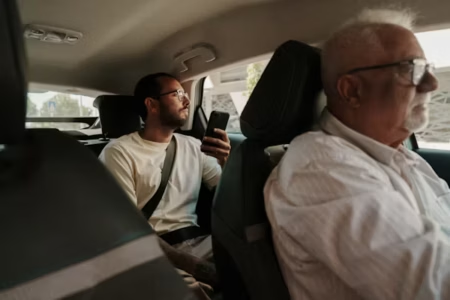
Another ordinary use case can be seen in a lifestyle portrait image turned into a short AI-generated moving visual. In this kind of example, the purpose is not dramatic animation, but light and believable motion that makes the original still image feel more dynamic and better suited for digital storytelling. This shows how image-to-video tools can support creators and marketers who want to repurpose existing visuals into engaging short-form content without building a full production workflow from scratch.
AI-generated animated version via ImageToVideoAI.net
What makes this practical is speed. Adobe’s recent creator data suggests that AI video tools are being used not only because they are interesting, but because they save time and support output demands that creators already face. That matters in environments where quick turnaround is often more important than producing a fully edited traditional video from scratch.
Why This Trend Is Likely to Continue
Image-to-video AI is in the intersection of two strong trends: the rise in popularity of video and the rise in the use of AI-based creative tools. Marketers and creators are still focused on video on the content side since it is very visible, has a high consumption rate, and can often be successful. On the workflow front, AI is continuing to reduce the effort required to create visual content using the existing resources. The two shifts are supplementary.
According to the 2026 creator-oriented reporting of Adobe, AI video tools are already impacting the watch time, engagement, and efficiency of creators. That is important because it shows these tools are moving beyond novelty use cases and into normal creative operations.
As a result, image-to-video generation is becoming less about spectacle and more about utility. Users are not always looking for cinematic complexity. Often, they simply want a still image to feel more alive, more engaging, and more suitable for modern digital formats.
Conclusion
The use of still images in digital storytelling is evolving with AI image-to-video tools. What was once a fixed visual image can now be a moving, expressive resource with little effort as compared to the traditional production that was needed.
That is important to multiple audiences. Families are able to re-experience significant memories in a more colourful manner. Producers are able to create content of interest more quickly. Brands are also able to use still images to create video-ready content without having to construct an entire production workflow.
The need to generate motion content with ease and produce subtle, realistic video with little more than a single image is likely to make the tools that enable this to be more practical and more common. This is also one of the most explicit instances of AI simplifying visual production, as opposed to complicating it, to users who want to create using memory-driven storytelling, or portrait animation, or to experiment with visual creation quickly.