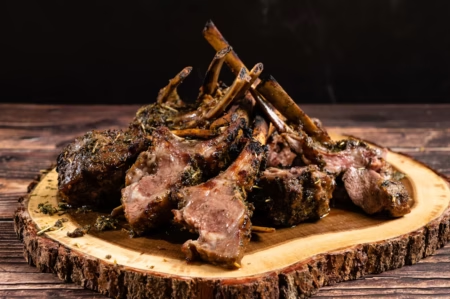
Food content has one of the more interesting relationships with video of any category on the internet. On one hand, it seems like a natural fit — cooking is a process, and processes unfold over time in ways that still photography can never fully capture. On the other hand, producing good food video is genuinely hard. The lighting requirements are exacting, the timing is unforgiving, and the margin between footage that makes a dish look irresistible and footage that makes it look unappetizing is narrower than most people expect before they try it.
Anyone who has run a food blog for more than a year has probably wrestled with this. Writing a recipe is one skill. Photographing it well is another skill that takes real time to develop. Filming it in a way that’s genuinely compelling is yet another layer on top of that, with its own technical demands and its own learning curve. Many food bloggers have built substantial audiences on the strength of their writing and photography alone, and adding video to the mix has felt like taking on an entirely separate creative discipline.
That calculation is shifting, and AI video generation is part of what’s shifting it.
What Food Video Is Actually Competing Against
The context matters here. A food blogger posting video content today isn’t just competing with other food blogs — they’re competing with professional food media, recipe platforms with dedicated production teams, and a generation of creators who have invested heavily in learning the craft of food video over years of consistent output. The production quality ceiling in food content is genuinely high, and audiences have become accustomed to it.
That doesn’t mean every food video needs to look like a Netflix food documentary. Authenticity has its own currency, and some of the most-followed food creators built their audiences precisely by not looking overly produced. But there’s a floor, and content that falls below it — badly lit, poorly framed, with the kind of amateur quality that signals low effort rather than intentional rawness — tends to underperform regardless of how good the underlying recipe is.
The challenge for independent food bloggers is occupying the space between those two poles: content that looks good enough to take seriously without requiring a production budget that makes it economically unviable.
How AI Video Generation Fits the Food Content World
Happy Horse is an AI video generation model that has found real traction in content categories where atmosphere and visual appeal matter more than documentary precision — and food is very much one of those categories. The kinds of shots that make food content compelling are often the atmospheric ones: steam rising from a bowl, the way sauce coats the back of a spoon, the golden color of something pulled fresh from the oven, the texture of a crust or a crumb in close detail. These are shots that convey feeling, and they’re shots that AI generation can produce with genuine quality.
For a food blogger, the value proposition is relatively straightforward. You’ve developed a recipe, you’ve tested it, you know what it looks like and what makes it special. The AI generation process lets you translate that knowledge into visual content without requiring you to simultaneously manage a camera, control your lighting setup, keep your hands clean enough to operate equipment, and cook the dish correctly all at the same time — which is the impossible juggling act that food video production actually demands of someone working alone.
Atmospheric Content vs. Process Documentation
There’s an important distinction worth drawing here between two types of food video. Process documentation — showing the actual steps of a recipe in sequence, with the actual timing and technique visible — still benefits enormously from real filming. Viewers who are trying to learn a technique need to see the real thing, and AI generation isn’t the right tool for that kind of content.
Where AI generation works well in food content is in what you might call the cinematic layer: the beautiful establishing shots, the evocative close-ups, the mood-setting footage that introduces a recipe or punctuates a longer piece. This is the content that makes a viewer stop scrolling, that makes a dish look worth making, that gives a food blog or channel its visual identity. It’s also the content that’s hardest to produce on your own without a proper setup, because it requires controlled lighting, careful camera work, and often multiple takes of a shot that has to be reset each time.
Using AI-generated footage for this atmospheric layer while maintaining real process footage for the instructional parts of content is a genuinely sensible hybrid approach. It gives the content the visual quality it needs to compete without requiring every shot to be produced from scratch.
The Social Media Dimension
Food content on social media lives or dies by its first few seconds. Instagram Reels and TikTok have made this even more acute — the scroll speed means that visually weak content gets passed over almost instantly, while something that looks genuinely appetizing can stop a user mid-scroll even if they weren’t actively looking for food content.
Producing enough content to stay consistently present on these platforms is its own challenge. A food blogger who posts three times a week needs a lot of visual material, and the production time required to film, edit, and polish even short clips adds up quickly. AI generation can function as a content multiplier here — extending the visual assets available for social posts without proportionally extending the time investment required to produce them.
There’s also the seasonal and thematic content cycle that food creators work within. The same basic capability that gets used to generate a warming, low-light visual for an autumn recipe can be shifted toward something brighter and fresher for spring produce content. Adapting the visual mood of content to match the food and the season is something AI generation handles reasonably well, and it’s the kind of creative flexibility that would otherwise require multiple different shooting setups.
Building a Visual Identity
One underappreciated aspect of AI video generation for food content is its potential role in building a consistent visual identity. The most recognizable food blogs and channels have a distinctive look — a particular color palette, a certain quality of light, a consistent way of framing and presenting dishes. That visual consistency is part of what makes a creator recognizable and part of what builds audience loyalty over time.
Achieving that consistency through real production requires either a very controlled shooting setup that you maintain across all your content, or a lot of post-production work to bring different shots into alignment. AI generation, because it works from prompts that you can keep consistent, can actually help establish and maintain a visual language more reliably than many real production setups — particularly for creators working alone without a dedicated studio space.
The result, over time, is a body of content that looks intentional and coherent rather than like a collection of individually produced pieces that happen to share a subject matter.
Knowing What It’s Good For
It would be a mistake to suggest that AI video generation solves everything in food content production, because it doesn’t. The irreplaceable elements of good food media — genuine expertise about flavor and technique, the ability to write about food in a way that makes readers hungry, the trust that comes from being someone who actually cooks and eats and cares — remain entirely human. Those are the things that bring an audience back.
What AI generation does is remove one specific bottleneck in translating that expertise into a format that the current content landscape rewards. For food bloggers who have spent years developing real knowledge and a real voice and found themselves limited by the visual production side of things, removing that bottleneck is more valuable than it might sound.
The recipe was always there. Now there’s a better way to show it off.