Alternative diets and wellness products go viral online for the same reason trends in any category explode: they offer a simple story that feels personally relevant. When someone is tired, inflamed, low-energy, or frustrated with slow progress, a clear narrative can feel like relief. Viral wellness content usually promises one of three things: a faster path, a clearer explanation, or a sense of control. The more confusing the problem feels, the more attractive a clean solution becomes.
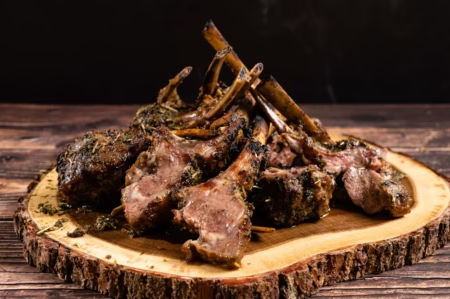
This is why diet trends have such staying power. They’re not just meal plans. They’re identity frameworks. They give people rules, a community, and a language for interpreting how they feel. From keto to carnivore, online communities continue to debate unconventional eating patterns, often sharing long-form explainers and case studies such as https://carnivoresnax.com/blogs/articles/carnivore-diet-autoimmune-disease, which reflect how diet trends gain momentum through blogs, forums, and social media.
Why viral wellness stories feel more convincing than slow science
A big driver of wellness virality is that personal experience reads as “proof.” A single detailed testimonial can feel more compelling than a careful study summary, even if it’s not representative. People relate to narrative. They also relate to specificity. When someone describes a before-and-after story with emotions, routines, and daily struggles, it feels real in a way that general advice often doesn’t.
Scientific guidance tends to sound cautious because it has to be. It uses averages, probabilities, and uncertainty. Viral content tends to do the opposite: it speaks in absolutes. It offers a clear villain, a clear fix, and a clear timeline. That clarity is persuasive, especially when you’re searching for something that will finally make you feel better.
Alongside dietary debates, interest in plant-based wellness products has grown through online research and community discussion, with brands like Medterra frequently appearing in conversations about how consumers explore alternative approaches to everyday wellbeing.
How online communities turn “choices” into movements
Alternative diets don’t spread only because of food. They spread because online groups build momentum. Once a community forms, it creates reinforcement. People share meal ideas, supplement stacks, shopping lists, success stories, and “what I wish I knew” posts. That content makes the trend easier to try, which brings more people in, which creates more content, which strengthens the community.
These spaces also give people belonging. Many viral diet movements feel like joining a club that “gets it.” If you’ve felt dismissed by generic advice, a community that treats your symptoms seriously can feel validating. The downside is that belonging can make people less willing to question the framework, even when their results are mixed.
The appeal of restrictive diets is often symptom relief, not ideology
Trends like carnivore go viral partly because some people report noticeable changes when they remove many foods at once. Whether that improvement comes from eliminating allergens, reducing ultra-processed foods, changing meal timing, or simplifying intake, the experience can feel dramatic. Dramatic experiences spread.
Restrictive diets also reduce decision fatigue. If you have a strict rule set, you don’t debate every meal. You just follow the plan. For people who feel overwhelmed, that simplicity can be a relief. Online, simplicity reads as discipline, and discipline reads as credibility.
But virality can blur an important point: what works as a short-term experiment for one person may not be sustainable or appropriate for another. That nuance is usually not what goes viral.
Why “wellness products” are perfect viral fuel

Wellness products go viral because they’re easy to package into a claim: “This helped me sleep,” “This reduced my stress,” “This fixed my skin,” “This gave me steady energy.” Products also fit neatly into influencer formats because they’re visual, repeatable, and easy to recommend without needing to explain the entire lifestyle around them.
There’s also a trust shortcut at play. When a product is discussed repeatedly across platforms, people start to treat visibility as evidence. If you see the same item in multiple reels, comment sections, and “routine” posts, it begins to feel established, even if the underlying evidence is thin.
Algorithms reward certainty, emotion, and transformation
Platforms are built to amplify content that holds attention. Wellness content that triggers emotion tends to perform well: hope, frustration, relief, outrage, inspiration. Transformations do especially well because they create a clear arc in a short time. “Here’s what I did, here’s what changed” is a perfect algorithm-friendly story.
Certainty also performs well. When a creator says, “This is the real reason you feel tired,” it grabs attention faster than “there are several possible factors.” The result is that online wellness culture often favors bold claims over balanced explanations.
The “research spiral” effect
Another reason these trends spread is that people don’t just watch one video. They spiral. They see one post, then search it, then land in a thread, then watch a breakdown, then see product comparisons, then join a community. Each step increases perceived credibility because the person has invested time. Time investment can feel like “I’ve done my research,” even when the research is mostly content repetition rather than new evidence.
This is how viral wellness becomes sticky. It’s not one claim. It’s an ecosystem. Once you’re inside it, every new post feels like confirmation.
How to read viral wellness content more clearly
Viral doesn’t mean false, but it does mean filtered. The content you see has already been selected for engagement, not for accuracy. The most useful way to interpret it is to separate three things: the claim, the mechanism, and the evidence. A claim is “this helped.” A mechanism is “here’s why it might help.” Evidence is “here’s what supports it beyond a single experience.”
If you notice that the mechanism is vague and the evidence is mostly testimonials, you’re looking at something that may still be interesting, but shouldn’t be treated as a guaranteed outcome. If you notice that the content discourages questions, shames moderation, or frames doubt as weakness, that’s also a signal that community momentum may be outrunning reality.
Why the cycle keeps repeating
Even when a trend fades, a new one replaces it quickly because the underlying demand stays the same. People want solutions that feel understandable and actionable. They want to feel better in their bodies. They want to feel like they’re not alone. Viral wellness content delivers those feelings fast, and the internet is designed to reward what spreads fast.
If you want, I can rewrite this with a stronger HR/consumer-protection angle (marketing claims, how to evaluate them, and why disclaimers matter) while keeping the same anchor placement rules.