

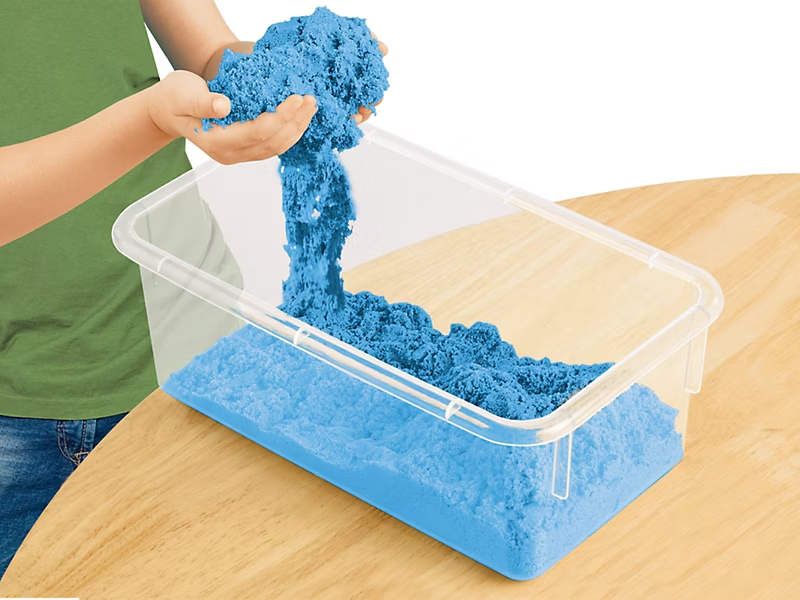

If you’re a parent and have ever had the pleasure of vacuuming kinetic sand from your carpet, or even trying to get it all in a broom pan, you probably already know where this article is going to. Sure it’s a great way to keep the kids quiet for a little bit but in my experience (and almost every other parent I’ve talked to) the clean up is not worth it.
It’s one of those toys that kids will outright beg for at the store. I mean, everyone loves crafts, the colors are cute (unless you mix them), and you’re able to make exactly what you want several times over.
I don’t think kids realize how horrible the experience is for stressed out parents until they actually observe the look of pain on your face when you’re trying desperately to get the sand out of the carpet.
History of Kinetic Sand
The history of kinetic sand goes back farther than you might expect. The original model was developed by Delta of Sweden in 1997. Then the sand caught the attention of toy company Spin Master, which helped transform the unusual sand into a recognizable children’s product.
On June 4, 2014, Spin Master licensed it and launched Kinetic Sand.
Sand is already one of the simplest toys out there. Seriously we all had that same green turtle sandbox with the shell lid. Kids started playing with this sand because there was just one ingredient added. So now our sandcastles and our sand art can be taken to the next level.

Then, Spin Master officially designated August 11 as Global Kinetic Sand Day in 2020. That’s right. The stuff embedded in your carpet has its own day. Unfortunately in my world it feels like Kinetic Sand Day is every day.
Why Kids Love Kinetic Sand
Adults sometimes look at children’s sensory toys and wonder how they can possibly remain entertaining for so long. Think about the basic functionality of the fidget spinner. Kinetic sand makes a little more sense once you actually handle it. There’s something strangely satisfying about it. You can squeeze it, cut it, crumble it, flatten it, mold it, and slowly let it fall through your fingers. Every action produces a slightly different sensation.
For younger children especially, those sensations can turn ordinary play into an opportunity to explore texture and movement. It also allows for imaginative play. One day the sand can become a construction site. The next day it’s a bakery. Add a few dinosaur toys and suddenly you’re conducting an archaeological excavation at the kitchen table. And parent to parent, no matter how old your kid is they will find a way to open it without you looking and play with it on the floor right next to their bed and make sure that sand gets in their sheets somehow. That may be oddly specific to some folks, but I promise you it’s happened to a lot of us
That versatility helps explain why children continue asking for it even when their parents have sworn they’re never buying another container.
Therapy Uses With Kinetic Sand
There are several ways that kinetic sand has been incorporated into therapeutic and educational activities. For example, in occupational therapy, children may practice writing by tracing letters in the sand. Instead of simply looking at a letter on paper, the child physically creates its shape. That adds a tactile element to the learning process.
Children can practice lines, curves, letters, numbers, and basic shapes while experiencing the movement through their hands and fingers. Playing with kinetic sand can also encourage fine motor skills. Scooping, squeezing, pinching, cutting, and molding all require children to use their hands in slightly different ways. The sand can also be incorporated into play therapy.

Simply kneading the material repeatedly may provide a calming sensory activity for some children. Rather than requiring them to sit perfectly still and explain what they’re experiencing, therapists can give them something physical to interact with.
Children may also use sand, figures, molds, or other objects to create scenes. Those scenes can potentially give them another way to express ideas or emotions that are difficult to communicate directly. That’s an important distinction because children don’t always have the vocabulary to explain complicated feelings. Play gives them another language.
From the child’s perspective, they may feel like they’re simply playing with a toy. At the same time, a therapist can use that activity as an opportunity to encourage communication, emotional expression, or development. It’s basically a cheat code for getting a child engaged in an activity without making everything feel like work.

Kinetic Sand Solves a Problem Nobody Had
This may be come as a surprise to you but: regular sand already exists. We somehow took one of the most obvious free toy out there, put it into little plastic containers, dyed it bright colors, and convinced parents to pay for the privilege of bringing it inside their homes. At least when kids play in a sandbox, the sand is already where sand belongs. Nobody looks at a sandbox and thinks, “You know what would improve this? Putting it on my dining room table.” Kinetic sand basically takes an outdoor mess and relocates it directly into your living space.
Then there are all the accessories. Suddenly, you’re not just buying sand. There are molds, tools, playsets, storage containers, themed kits, and whatever else companies can convince your child is absolutely necessary. Inevitably, half of those little pieces disappear, the colors get mixed into one depressing brownish lump, and some of the sand escapes into your house.
That’s what makes kinetic sand such a dumb toy from a parent’s perspective. The entire selling point is that kids can enjoy playing with sand without going outside, but going outside was the one thing keeping the sand out of my carpet. We’ve taken a perfectly functional outdoor activity, made it more expensive, brought it indoors, and created additional cleanup for ourselves.
Congratulations. We invented worse sand.
Most Common Injuries from Kinetic Sand
- Choking: Small children may try to eat the moldable sand, which can block airways. If you’re a parent and you kid sticks everything in their mouths, definitely watch out for this one
- Gastrointestinal Obstruction: Eating large amounts can cause the sand to pack together in the digestive tract, leading to blockages. Now I don’t know anyone personally that can eat large amounts of sand but there is always on kid in the group that will dare you to do something stupid.


Click here to read the study on the effects that sand had on a three yr old little boy after ingesting a fair amount of it.
- Stomach Discomfort: Swallowing smaller amounts can still cause vomiting, throat pain, constipation, or abdominal pain. Because Ya’ll, human beings aren’t supposed to eat sand. Period.
- Eye Irritation: Fine grains can get into the eyes during play, causing redness, pain, and a gritty feeling. This type of injury is my hell and if anything lands in an eye it’s uncomfortable AF.
- Skin Irritation: Though rare, the materials can occasionally cause minor allergic reactions, rashes, or skin redness.
Sensory Play for Kids, Sensory Hell for Parents

This is where my relationship with kinetic sand gets complicated. I understand why kids love it. There’s a reason why teachers, occupational therapists, and play therapists find it useful. I even understand why parents keep buying it.
What I don’t understand is how approximately three tablespoons of kinetic sand can somehow cover 900 square feet of a house.
The package makes everything look so controlled. There’s a happy kid calmly molding a beautiful little sandcastle while every grain remains exactly where it’s supposed to be. That’s not how this goes down in my house.
Eventually, somebody gets excited. Somebody drops something. Somebody decides the floor would make an excellent secondary workspace. Then the cleanup begins.
Hard floors are tricky because while you can sweep it up there’s almost always a spot you missed. They will definitely step in it and track it everywhere. Carpet however, is where kinetic sand becomes your mortal enemy. Those tiny particles work their way into the fibers, and suddenly you’re running the vacuum over the same spot repeatedly.
You think you’ve gotten everything.
You haven’t.
You’ll find more tomorrow.
That’s what makes kinetic sand such a strange parenting experience. As a children’s toy, I can admit it’s pretty brilliant. It’s creative, reusable, tactile, and endlessly customizable.
As the person responsible for cleaning the house, I want it nowhere near my carpet.
Maybe that’s the real compromise parents need to make with kinetic sand for kids. Don’t ban it completely. Just establish some very serious boundaries before opening the package. Use a tray. Put down a mat. Keep it away from carpet. Consider making kinetic sand an outdoor activity when the weather cooperates.
Most importantly, don’t believe your child when they confidently tell you, “I won’t spill it.”
They will.
And you’ll be vacuuming.
Get Yours Now!
If you hate yourself the amazon link is here. Don’t say I didn’t’ warn you.


