Running a trucking company on spreadsheets and disconnected tools eventually creates operational problems for a growing carrier. Dispatch data may live in one system, while accounting and compliance tracking operate somewhere else. These disconnected tools often struggle to communicate with each other. A transportation management system helps solve that problem by bringing important operations together. However, the five platforms below take different approaches to addressing these challenges.
Top 5 Carrier TMS Platforms Compared
1. PCS TMS for Carriers
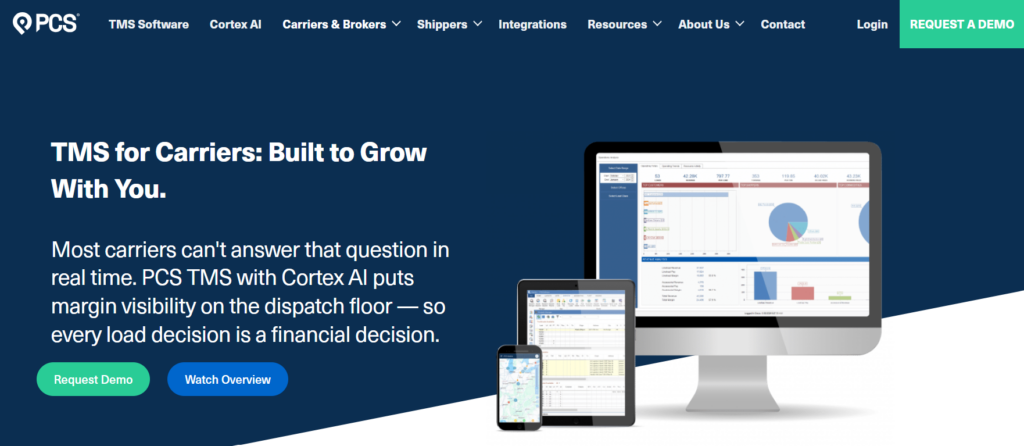
PCS TMS for carriers combines dispatch, accounting, fleet management, and broker compliance within one platform instead of relying on separate tools. Its Load Opportunity Manager captures freight from broker emails, EDI feeds, and load boards before evaluating available opportunities. The system then ranks each opportunity against the carrier’s individual profit rules. Natural language search also allows dispatchers to ask straightforward questions instead of manually creating complicated filters.
Dispatchers can manage operations from anywhere through the PCS Mobile App. They can create loads, assign truckload, LTL, and intermodal freight, and communicate directly with drivers using two-way messaging. On desktop, Cortex recommends driver and equipment matches by evaluating more than 36 different data points.
Backhaul Booster searches a carrier’s network to identify profitable return legs and automates outreach to secure them. This process includes AI-generated shipper emails and voice-agent calls. Fleet management tools centralize maintenance reminders, compliance notifications, and cost tracking. Meanwhile, built-in accounting handles AR/AP, payroll, and driver settlement without requiring users to switch between different systems.
Reporting provides additional visibility into daily operations. Customizable profitability dashboards, fuel and mileage optimization tracking, automated compliance filings, and unlimited data exporting help carriers evaluate performance.
Carriers handling both asset and brokered freight also have access to broker compliance tools. These tools vet carriers against FMCSA and SaferWatch data during dispatch while providing automated fraud alerts through a Highway integration.
PCS targets asset-based carriers operating between 50 and 1,000 trucks. At this size, spreadsheets and disconnected workflows can become increasingly difficult to scale effectively. Most carriers can become operational within 30 to 90 days after signing.
The platform earned a place on Inbound Logistics’ 2026 Top 100 Logistics & Supply Chain Technology Providers list. It was also recognized as a Front Runner for 2025 “Top Transportation Management Systems” and appeared on Capterra’s Fleet Management Shortlist. Andrew Suciu, Chief Strategy Officer at Voyager Express, has also described the platform as significantly changing how his team operates.
2. McLeod Software (LoadMaster and PowerBroker)
McLeod Software has remained a familiar option among large truckload carriers for decades. LoadMaster and PowerBroker are particularly suited to fleets operating approximately 500 trucks or more. Its AI investments include RespondAI, which prioritizes inbound communications and helps draft responses. MPact.Rate provides market rate analysis using data contributed nightly by active McLeod carriers and brokers.
McLeod holds a 4.1 out of 5 rating on G2 across 42 reviews. It also offers more than 260 integrations and works with 140 certified partners. Its AI-powered Order Creation Interface automatically converts unstructured email information into order entries.
The platform’s depth and established market presence come with certain considerations. Implementation and onboarding can require more time and internal resources than lighter platforms designed around faster deployment.
3. Trimble TMS (TMW.Suite and TruckMate)
Trimble’s enterprise TMS lineup includes TMW.Suite for full truckload carriers and TruckMate for LTL and intermodal operations. The company states that its technology powers 60 percent of North America’s top 200 fleets.
Its Dispatch Advisor evaluates several operational variables simultaneously. These include location, remaining hours of service, and delivery windows. The system uses this information to recommend appropriate driver and load matches.
Trimble’s newer Arc Agent extracts freight order information directly from PDF and text files. It then submits that information into TMW.Suite, reducing the need for manual data entry.
The platform suits carriers looking for enterprise-grade capabilities with room for significant operational growth. However, that scale can bring a longer implementation timeline. Larger deployments may also require greater internal IT involvement than smaller TMS platforms.
4. Alvys
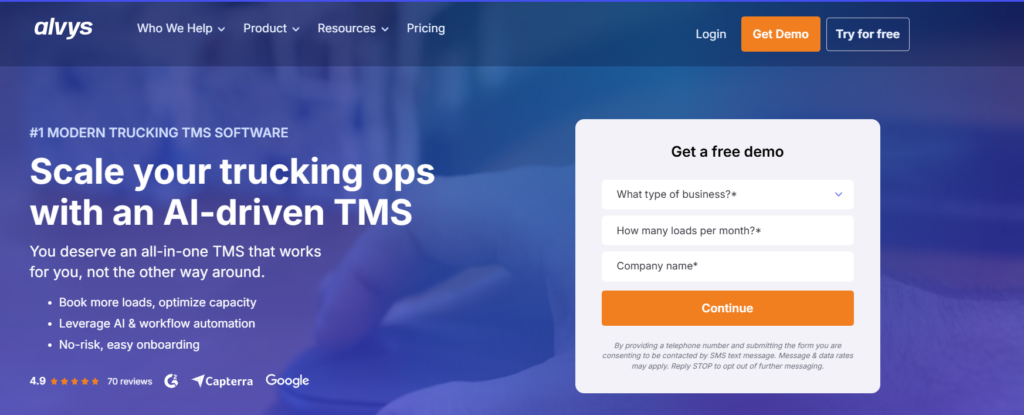
Alvys approaches transportation management differently with a cloud-based, quote-to-cash platform. It targets carriers, brokers, and hybrid operations looking to move away from spreadsheets without undergoing a lengthy implementation process.
Native EDI represents one of the platform’s notable features. The technology comes directly within the platform instead of requiring a separate third-party integration. The company states that carriers can become operational within days rather than weeks.
Alvys includes unlimited users and business divisions without additional costs. Its driver mobile app also automatically enhances photographed documents to produce cleaner digital scans.
The platform connects with more than 120 integrations. These include major ELD providers, load boards, and accounting software. Alvys generally targets small to mid-sized carriers seeking to consolidate their existing tools. It may be less suited to large enterprise fleets managing complex multi-terminal operations.
5. Rose Rocket (TMS.ai)
Rose Rocket, now operating under the TMS.ai brand, focuses heavily on configurability. Its platform uses no-code customization instead of requiring carriers to follow rigid, predefined workflows.
Three named AI agents handle different areas of the process. TED processes incoming emails and converts information into orders. Rosie provides order insights and assists with completing updates. Rocky, which is still rolling out, is designed to assist with onboarding.
According to its published pricing page, the Full Service tier starts at $2,080 per month. It includes unlimited users and comes with a 90-day go-live guarantee. An Enterprise tier with custom pricing is also available for carriers requiring dedicated account management and expanded security controls.
Rose Rocket connects with more than 20 pre-built integrations spanning ELD, load board, and accounting systems. Its no-code “Builders” tool gives operations teams additional control. Teams can configure custom fields and automations without waiting for the vendor’s development backlog.
What to Weigh Beyond the Feature List
Implementation timelines vary considerably between these platforms, making deployment speed an important consideration alongside pricing. A carrier needing a functional system within days has different requirements from one preparing for a multi-month enterprise implementation.
Business urgency should help determine which approach makes sense. Choosing the longest feature list provides little value if implementation requirements conflict with a carrier’s immediate operational needs.
Fleet size and future growth also deserve consideration. A platform designed for 25 to 100 trucks may begin showing limitations as the fleet expands. Conversely, an enterprise platform designed for hundreds of trucks may introduce unnecessary complexity for smaller operations.
The underlying reason for adopting a TMS should remain part of the evaluation. Coverage of smart logistics adoption cites Gartner research showing measurable benefits from digital supply chain technology. Companies investing in these technologies see delivery performance improve by 20 to 30 percent compared with businesses relying on manual processes. That performance difference represents the broader gap carriers are attempting to close, regardless of which platform they ultimately select.
Conclusion
There is no single best carrier TMS for every trucking company. Fleet size, implementation speed, operational complexity, and available internal IT support can all influence which platform makes the most sense.
Alvys prioritizes rapid deployment, while PCS combines a 30 to 90 day implementation with dispatch, accounting, and compliance capabilities. McLeod and Trimble provide decades of enterprise-scale experience for larger fleets. Rose Rocket focuses heavily on no-code configurability for carriers managing more complex or non-standard workflows.
Matching the platform to actual fleet size and operational requirements can produce a stronger long-term fit. Familiarity with a brand does not necessarily mean it provides the best solution. Carriers should prioritize practical requirements rather than simply choosing whichever platform offers the longest feature list.
Frequently Asked Questions
1. How long does it typically take to implement a carrier TMS?
Implementation timelines vary significantly between platforms. Some carriers can become operational within days when using lighter systems designed for rapid deployment. Enterprise platforms serving large, multi-terminal fleets may take several months to implement. Extensive customization or greater IT involvement can extend that timeline further.
2. What fleet size actually needs a dedicated TMS instead of spreadsheets?
Many carriers begin experiencing the limitations of manual tracking somewhere between 25 and 50 trucks. At this point, dispatch, billing, and compliance information becomes increasingly difficult to manage through disconnected spreadsheets and phone calls.
3. Do all carrier TMS platforms include accounting, or is that a separate add-on?
Accounting capabilities depend on the vendor. Some platforms include AR/AP and driver settlement directly within their core systems. Others require carriers to integrate separate third-party accounting software. Confirming these requirements before choosing a platform can prevent unexpected costs or additional integrations.
4. Is a more expensive, enterprise-grade TMS always the better choice?
Not necessarily. Platforms built for hundreds of trucks and multi-terminal operations can introduce unnecessary complexity for smaller carriers. They may also require significantly longer implementation timelines. Matching the platform to the carrier’s current fleet size and operational needs often matters more than choosing the most feature-dense option.