



Artificial intelligence has transformed the way people create written content. From blog posts and marketing copy to emails and academic drafts, AI writing tools can produce text in seconds. As a result, many readers now wonder whether they can tell the difference between AI-generated content and writing produced by humans.
While modern AI models have become remarkably sophisticated, they still approach writing differently than people do. Human writers rely on experience, emotions, personal judgment, and contextual understanding, whereas AI generates text by predicting the most likely sequence of words based on patterns learned from enormous datasets.
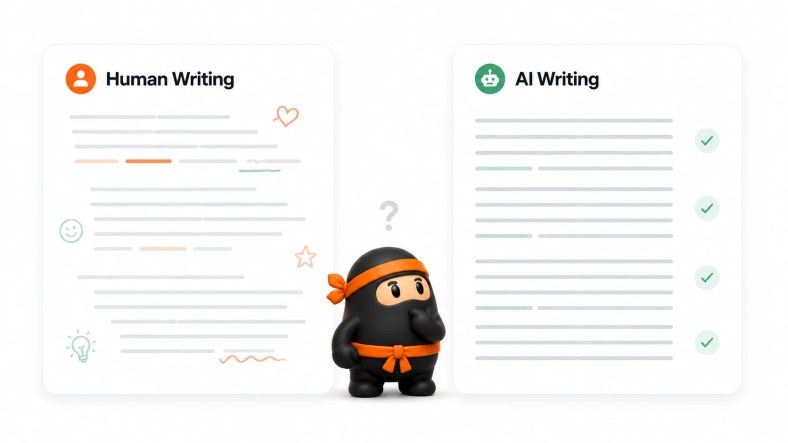
Understanding these differences is useful for writers, editors, businesses, students, and anyone who regularly consumes online content.
1. Human Writing Reflects Personal Experience
One of the biggest distinctions between AI and human writing is the presence of genuine personal experience.
Humans naturally include observations from their own lives, lessons learned from mistakes, unexpected discoveries, and opinions shaped by real events. Even when two people write about the same topic, their perspectives often differ because of their unique backgrounds.
AI, on the other hand, does not possess personal memories or experiences. It can describe situations convincingly, but it cannot truly write from firsthand experience unless that information is explicitly provided by the user.
This is why travel blogs, product reviews, opinion pieces, and personal stories often feel more authentic when written by someone who has actually lived through the experience.
2. Emotional Nuance Is More Natural in Human Text
Human communication involves subtle emotional signals.
People naturally adjust their writing depending on the audience, mood, relationship, and purpose. Humor, sarcasm, empathy, excitement, hesitation, and even vulnerability appear organically in human writing.
AI can imitate emotional language, but it often produces emotions in a more formulaic way. The wording may sound correct while lacking the subtle imperfections that make genuine communication feel authentic.
Readers frequently recognize this difference even if they cannot explain exactly why a passage feels “too polished” or “slightly artificial.”
3. AI Tends to Be More Predictable
Language models are trained to generate statistically probable text.
Because of this, AI often prefers:
- common sentence structures;
- safe vocabulary;
- balanced arguments;
- predictable transitions;
- conventional phrasing.
Human writers regularly break these patterns. They may use unexpected metaphors, unusual sentence rhythms, incomplete thoughts, or creative expressions that make their writing distinctive.
This unpredictability often makes human writing more engaging.

4. Humans Make Intentional Stylistic Choices
Every experienced writer develops a recognizable style.
Some prefer short, direct sentences. Others enjoy long analytical explanations. Some use humor frequently, while others maintain a formal tone throughout.
These choices are intentional and usually remain consistent across different pieces of writing.
AI can imitate many styles, but without detailed guidance it often defaults to a neutral voice designed to appeal to a broad audience. As a result, AI-generated articles from different sources can sometimes sound surprisingly similar.
5. Context Goes Beyond Words
Humans naturally understand context that extends beyond grammar.
For example, people recognize:
- cultural references;
- inside jokes;
- historical background;
- current events;
- audience expectations;
- social dynamics.
Although AI models possess extensive knowledge, they may occasionally misunderstand subtle context or miss implications that seem obvious to human readers.
This difference becomes particularly noticeable in satire, political commentary, legal writing, and highly specialized industries.
6. Human Writing Often Contains Productive Imperfections
Perfect writing is not always the most convincing.
Humans naturally vary sentence length, occasionally repeat ideas for emphasis, change rhythm unexpectedly, and sometimes use fragments instead of complete sentences.
These small imperfections make text feel natural.
AI frequently produces writing that is grammatically correct but mechanically balanced. Every paragraph may have similar structure, every sentence may be complete, and transitions may appear overly smooth.
Ironically, writing that is technically flawless can sometimes feel less authentic.
7. AI Excels at Speed and Consistency
While human writing has many strengths, AI offers significant advantages as well.
AI can:
- generate drafts within seconds;
- summarize large amounts of information;
- rewrite text in different tones;
- translate between languages;
- maintain consistent terminology across long documents.
These capabilities make AI an excellent productivity tool for brainstorming, editing, research assistance, and content scaling.
Human writers usually require considerably more time, especially when producing long-form content.
8. Critical Thinking Still Depends on Humans
AI can organize information and present logical arguments, but it does not independently evaluate evidence or develop original insights.
Human experts compare sources, question assumptions, identify contradictions, and introduce new perspectives based on their knowledge.
For subjects requiring professional judgment—such as medicine, law, scientific research, or investigative journalism—human expertise remains essential.
AI works best as an assistant rather than a replacement for critical thinking.
9. AI Detection Looks for Writing Patterns
The rise of AI-generated content has also led to the development of AI detection tools.
Rather than identifying whether a machine “wrote” a document, these systems estimate the probability that a text follows statistical patterns commonly associated with AI.
Typical signals include:
- repetitive sentence structures;
- unusually consistent formatting;
- low linguistic variation;
- highly predictable word choices;
- repetitive transitions.
However, no detector is perfectly accurate. Human writing can occasionally receive high AI scores, while carefully edited AI content may appear more natural.
For this reason, AI detection results should generally be interpreted as probability estimates rather than definitive proof.
10. The Best Results Often Combine AI and Human Editing
Today, many professional writers use AI as part of their workflow instead of relying on it completely.
A common process looks like this:
- AI generates an initial draft.
- A human verifies facts and accuracy.
- The writer adds expertise and personal insights.
- The content is edited for clarity and flow.
- Final revisions improve readability and remove repetitive patterns.
This combination allows creators to benefit from AI’s speed while preserving the authenticity and originality that readers value.

Conclusion
Artificial intelligence has dramatically improved the efficiency of content creation, but human writing continues to offer qualities that algorithms cannot fully reproduce. Personal experience, emotional authenticity, creativity, critical thinking, and genuine perspective remain distinguishing features of human communication.
Rather than viewing AI and human writers as competitors, many organizations now see them as complementary tools. AI can accelerate drafting and research, while humans provide judgment, originality, and meaningful storytelling.
As language models continue to evolve, the gap between AI-generated and human-written content may become smaller. Nevertheless, the ability to communicate authentic experiences and original ideas will remain one of the defining strengths of human authors.
Humanizing AI-Generated Content
For writers who already use AI but want their content to sound more natural, specialized humanization tools can help refine wording, improve sentence variety, and reduce repetitive AI patterns. Platforms such as Humanio AI are designed specifically for this purpose, helping transform AI-assisted drafts into text that reads more naturally while preserving the original meaning.


